 Yes, that's me in a Santa Costume. I've worn a lot of silly things in my life- a kilt, beret, a tuxedo, various capes and cloaks, an altar boy's alb, an executioner's hood, a nun's habit, pirate garb, a Boy Scout uniform, chainmail, a pith helmet, etc. But I thought that I had some sort of autobiographical immunity to ever dressing up as Santa. Hahaha! How wrong I was! Japan has seen to it that I must now "Santa Suit" to this list of Silly Things I've Worn. I was kind of hoping to give that one a pass. More on this later...
Anyway...
My parents have this horrible tape that they play every year. It's called Perry Como Sings Merry Christmas Music. This thing is awful. Pure waves of scholck and non-ironic kitsch radiate from the speakers when this thing plays. In my set of mental signifiers, the stress and travails of holiday travails are summed up nicely in the crooning cadences of Perry Como wandering through an insufferable rendition of The Twelve Days of Christmas.
Wait, what I am I saying? That's totally redunant. All renditions of The Twelve Days of Christmas are insufferable. That repetetive, banal ballad is possibly the worst song ever. Even worse than Abracadabra by the Steve Miller Band. And who really wants a bunch of lords-a-leaping anyway? And when are the twelve days of Chirstmas? Boo this song!
Anyway...
So, there's this Perry Como Chrstmas tape that I can't stand. I thought that being in Japan would be a good opportunity to miss out on all the things that I don't like about Japan- the family stress, the horrible songs, the consumerism, etc. I was somewhat wrong about a few of these things.
You see, they have Christmas over here in Japan. Granted, it's different than in the States, but it's still very much here. The stores and malls are decked out with red and green, there are lights everywhere, and when you walk through any public space, you can hear hideous, hideous Christmas music.
Like Perry Como.
I was in Okayama station, and suddenly noticed the music on the PA system. It was familiar- very familar. It was something that I'd heard before, something familar in a strange way. It was, of course, Perry Como singing his hideous and saccharine version of The Twelve Days of Christmas.
Even with a Political Science degree, I hated American cultural hegemony more then than ever at this moment. No amount of intellectualizing can match the visceral disgust of audiophonic repulsiveness making its way across the vast Pacific. (Of course, I basically owe my job to American cultural hegemony, but that's another rant.)
Why couldn't it have been Tony Bennet or Frank Sinatra or Dean Martin or somthing? Those guys were cool. They were suave, well dressed, charismatic, and smooth and stuff. If Tony or Frank or Dino belted out some kitschy Christmas music, even they could probably make it sound nifty and sexy. But no. It was Perry Como, their insufferable imitator.
I cringed as I made my way to Kurashiki.
Meanwhile...
Every year my school has a Christmas party. And, every year, some poor sap has to dress up as Santa. The students and teachers all bring a small gift (nothing more than 500 yen) and everyone puts it in a bad, and Santa (this year, me) randomly gives everyone a present.
I basically got stuck with the Santa job because I'm new and everyone else said "not it" before I could. One of my managers approached me earlier this week and told me that I would have to be Santa, and that I had be be "genki" about it. "Genki" in Japanese literally means "healthy," but it's also used to mean happy, enthusiastic, and nifty and such.
Mr. Ecaudor obligingly dressed up in a reindeer hat to help me hand out the presents, and I must say that I do belt out a damn genki "ho ho ho!"
It was fun. Lots of fun, actually. Us teachers and a bunch of the students went to karaoke afterwards, for lots of Christmas karaoke action. British Girl and I sang a duet of Fairytale of New York by the Pogues, which is basically the best Christmas song ever, but the humor, irony and slight mournfulness of the song was lost on our Japanese audience.
However, a good time was had by all, and I returned home feeling downright festive. I'm missing Christmas this year- no friends, no family- but at least I got trussed up in fake beard and silly hat for the first time.
Ho ho ho.
Dec 9, 2006
In Which I Become Ridiculously Attired, But Am First Haunted by the Hungry Ghost of Perry Como


Dec 8, 2006
Is this post emo? God, I hope it isn't emo. It might be. Oh well.
I'm starting to feel it- I'm starting to feel the first pangs of homesickness.
I'm not writing in despair or anything, well, not yet, but I'm definitely missing Oregon. It's weird. It's not really an all-pervasive thing- it's more like every so often, for a period of about fifteen or twenty minutes I will intensely miss home.
I was in a 100 yen shop (100 yen is just under a dollar, and 100 yen shops have basically everything in them) and this Marvin Gaye song started playing on the PA system. I don't know which song it was, but I recognized the voice. It had been Japanese pop a moment before, and suddenly it switched to Marvin Gaye. I was looking at plastic containers to use as classroom organizers, and stood far back enough so that I could only see the Arabic numerals on their labels. I squinted a bit, lost sight of the Japanese script below the numbers, and listened to Marvin Gaye for a few moments. For a few moments I thought about what it would be like if one of the salespeople came up to me and said, "excuse me, is there something I can help you find."
And that was it- that was my momentary fantasy and reverie for a period of about one minute in store. My fantasy had no weirdness, no sex, no outlandish things such as dinosaurs or UFOs- just a momentary daydream about being able to speak, however prosaically, to a stranger. I think that's when I knew that it was starting, that I was dropping ever so slightly down the curve of the chart, that I was about to find out what it was like to miss home.
Since then, I've had moments- nothing traumatic, but moments where the awareness of my incredible situation is eclipsed by my awareness of my separation. For a few moments I seem struck by a bizzare blindness wherein I no longer am curious about where I am, where I do not try to figure out Japanese speech, where I do not attempt to learn new things. Instead, I simply want something familiar.
After the fact, these moments are frustrating. I'm here to learn, and to have moments where I occasionally rebel from my ambitions seems emotionally and intellectually cowardly. However, I know that those after-the-fact reflections are in themselves immature, that homesickness is something natural and expected, an extension of one's love for family, friends, home, etc. It would be pathological in its absence.
I know that I will adapt. I know that I will develop something like a simulacrum of a "life" here (I'm already doing that, really) and put my mind at ease. But for now twenty minutes of sadness surprise me every so often. It will not lasts, but it pangs while it persists.
Dec 5, 2006
An Open Letter to a Cyclopean Modernist
This post has nothing whatsoever to do with Japan. Instead, it's about a book. Ok, there's a little about Japan. But it's mostly book stuff.
Dear James Joyce,
I'm sorry. I'm very, very sorry. I take it all back. Ok, most of it. There's probably some stuff I don't remember. Anyway, sorry about that.
The point is, I've talked a lot of shit about you in the past. Unjustified shit. Shit that I wish I could unshit. I'm very sorry. For some godunknown reason, I thought that it would be "cool" or "hip" to make blanket judgements about you. You see, lots of people really, really like you. "Hey, that James Joyce is really revered and respected," I thought, "that probably means he sucks!" And knowing what I did about the incomprehensibility of Finnegan's Wake, I thought that was probably true, that the only people who actually read you were musty literary professors and pretentious guys with beards.
I decided that I needed some justification for hating you so much, so I did end up reading A Portrait of the Artist as a Young Man. And you know what? I hated it. I felt so justified. "Yeah," I thought, "this does suck!" Now, I'm not taking that back. The first time I read Portrait, I did hate it. I'll explain why.
I identified with it far, far too much. Stephen's struggle with and subsequent rejection of Catholocism, his musings about aesthetics, and his longing to leave Ireland cut way, way too close for me. I disliked to book because it made me uncomfortable, like a stranger who can give you an overly accurate description of your situation. I was also in a somewhat bad position then- for a variety of reasons I thought that I was "done" growing up, that I'd put aside fancies and ambitions. Both I and my girlfriend at the time had convinced ourselves that we wanted stable, ordinary jobs. Reading about Stephen and his ambitions was too cutting. Here was a book about someone whom I related to far too much, who resolved to do the sort of thing that I longed for but had shirked from. The idea was disturbing, and so I said, "I hate this book."
I've recently reread Portrait here in Japan, and the experience was entirely different.
I did not approach it from a standpoint of frustrated longing this time. Rather, it was from a standpoint of doing. Here I am, now, in Japan, and instead of resigning myself to a life that I do not want, I feel I'm now "encounter[ing] for the millionth time the reality of experience." Here in another country I am no longer the shirking, guilt ridden Stephen who walks sullenly down the streets of Dublin demonizing his own desires. Instead, I feel much more akin to the later Stephen, the invoker of the "old artificer" who has gone forth to actually do something with his life.
So, Mr. Joyce, I loved the book. Loved it. When I put aside my cynisim and pretentions, when I approached it with a new perspective and an open mind, I thought it was excellent. Admittedly, I didn't think that it was necessarily the third best book ever written in English, but I believe that it was Tolstoy who said that "Shakespeare is actually quite good, despite all of the people who say he's quite good." I think the same could be said about you.
Something that I did not catch when I first read the book was that the writing style very clearly mirrors Stephen's mindset at the time. This is stupidly obvious, in hindsight, but from the first page with the baby-talk to the end parts which are reminiscent of a Socratic diologue, the novel does not describe Stephen, it is Stephen in a way. It seems to me that the very ending of the book, where the third person narration ends and the reader is suddenly plunged into Stephen's journals, represents a sort of epiphany and maturity on the part of the main character. It is as if, through the use of epistolary, he has gained the ability to be self-representative.
Quite frankly, the book left me feeling what I like to call "jazzed." "Yeah," I'm thinking to myself, "I want to have aesthetic epiphanies and do stuff! Whoo-hoo! Fire up the smithy of my soul, yo!" I admit it, Mr. Joyce. You make me feel all fuzzy and artsy inside.
Sincerely,
SonicLlama, The Hired Tongue
P.S.
I made a note of this passage when I came across it. Here, Stephen is speaking with an English priest and realizing that English was exported to Ireland, and that for his ancestors it was a borrowed language. This is a great passage (if a little unsettling) for one teaching or learning a new language:
"The language in which we are speaking is his before it is mine. How different are the words home, Christ, ale, master, on his lips and on mine! I cannot speak or write these words without unrest of spirit. His language, so familiar and so foreign, will always be for me an acquired speech. I have not made or accepted its words. My voice holds them at bay."
Of course, when viewed in context of later events this passage actually takes on a hopeful tone. Not only does Stephen "accept its words," he does grand things with them. Here's hoping, then, both for me and my students.
Dec 2, 2006
Myst as Metaphore
I'm going to geek out in this post. A lot.
In Mark Haddon's most diverting yarn, The Curious Incident of the Dog in the Nighttime, the prepubescent autistic narrator must travel alone to London. He's never done this before, and his youth and autism both make the task something very difficult for him. To make the task easier for himself, he thinks of the whole thing like a video game, a video game he calls Train to London. He thinks of all the things that he needs to do to "solve" the video game- buying a ticket, figuring out the schedule, finding his platform, etc. He likens it all to Myst, a game where the player is simply dropped into an unfamiliar environment and must figure out what the hell to do simply given cues around them.
That's kind of where I'm at right now. Not speaking Japanese or understanding various conventions is a little like being bewildered and autistic, and the whole thing is a bit like a video game called Living in Japan. Every day I go out and try to "solve" bits of this game. Language puzzles mostly, but also exploring my environment and deducing social and cultural conventions by watching people do things.
I'm playing the fourth Myst game right now. At once it is quit nice to have something familiar- I've been following the series since the first game was released- but at the same time I'm sort of struck with the absurdity that I go out all day and puzzle things out, study Japanese and try to puzzle it out, and then pop a DVD into my computer wherein I try to puzzle out fictional things. Maybe I'm some sort of brain masochist.
But, the whole process is both frustrating and rewarding. It's frusrating that I can't fluently read hirigana and katakana yet, and it's frustrating that I get stuck on the "turn on the power" puzzles in Myst (because every Myst has at least one "turn on the power" puzzle). But, at the same time, both sort of experiences constantly yield intellectual rewards. Last night I saw "sareda" in katakana on a menu, and thought "yeah, salad." I was quite happy that I was able to read something so prosaic and utilitarian. Likewise, in Myst there is always the rewarding experience of making one more thing happen. More often than not it's not something big, it's more along the lines of "oh, so that's what this button does." Small "salad" moments.
Certainly, I will never get to the point with regards to the Japanese language or Japanese culture where I have dramatic moments. The moments in Myst where a bunch of gears grind together, the power turns on, and a bridge dramtically lowers. No, in the real world I'm going to have to content myself with "what does this button do?" Little things. "Salad" moments.
Incidentally, the fourth Myst game (Revelations, it's called) is as mind-bending as ever. It doesn't have the feeling of creepy alone-ness that made the earlier ones so good, but the puzzles are fun- there's even one where you have to work out the phonetics of a fictional alphabet.
Yay fictional alphabets! You're what I have fun with when I'm tired of working on real alphabets!
Yup, total brain masochist geek type here.
Nov 28, 2006
Unrespectable Mythology: The Htichhiker, Cursed Kleenex, and Hanako-San

You know the story of the Vanishing Hitchhiker, right? Today, I did what I thought was impossible- I scared someone with it. I thought that everyone and their dog had heard that story, but today I actually frightened one of my students with it. It's nice to know that if you haven't heard that story a million and a half times, the tale really does have a bit of ghostly "oomph" to it.
There's a lesson in our textbooks all about the past simple and past continuous, and urban legends are the topic of conversation. So, for one brief moment the textbook becomes much less like a staid english text, and more like The Transitive Vampire.
My student walked in, sat down, and looked at me. "I want to tell you a story," I said.
"Ok," she said.
"I was driving one night through a dark forest- there are plenty of those in Oregon -and was far away from town. It was raining a little and off to the side of the road, I saw a young woman with her thumb out." I mimed thumbing a ride.
"She wanted a ride?"
"Yes. I let her in. She didn't talk ver much, and I let her off at a house in town. But, when I got home, I noticed she'd left her jacket in my car." By this point, my student was fully able to tell that I was telling a "scary" story. I'd let my voice drop a little, let my left hand splay out on the table, and gestured broadly with my right. I might as well have had a flashlight under my face.
"What happened?" she asked with obvious anticipation.
"I went back to the house where I let her off the next day, and rang the doorbell. An old, old woman answered the door."
"An old woman?"
"Yes. I told her the jacket belonged to a young woman who lived there. 'there's no one like that here,' said the woman."
"What?" said my student.
"I was surprised, too," I said, maintaining my role as narrator, "But I saw woman's picture above the fireplace. 'Her,' I said, 'this is her jacket.'
"'There must be some mistake,' said the old woman, 'that's my daughter-" and here I looked my student directly in the eye and let it be known that I was pronouncing the zinger, "'she was killed twenty five years ago while hitchhiking!'"
"NO!" My student grabbed the ends of the table, and looked at me, startled.
"YES!" I said emphatically, "SHE'D BEEN DEAD THE WHOLE TIME!"
"YOU SAW A GHOST!" My student panted, and here eyes were approximately the size of dinner plates.
"No," I said, "I didn't. That never happened to me. That's an urban legend, a type of story, and it's the topic of today's lesson about the past simple and past continuous..."
In the prepared materials there were several other urban legends incorporated into the lesson, such as the Stolen Kidney Legend, the Hookhand Legend (one I've always found curious- If you had a hook for a hand, why would you try to open a car door with it?), the Man In the Backseat, and the ever-creepy Tale of the Babysitter.
I love urban legends,folklore itself is a fascinating area of study, and urban legends demonstrate that it's not just a hoary academic field exclusively about old German stories. Mythology is actually happening right now. And they have a weird creepiness to them- they come from nowhere, they star no one but stock roles, and the twists are as inevitable and often obvious, but they've got something to them.
So, I've yet to find a good website on Japanese Urband Legends, but I asked Hip-Hop about them, and he told me a few good ones:
A man was cleaning up one night around his restaurant, and found a stray dog rummaging through the garbage. The dog was mangy, dirty, and stank. The man hit the thing with his broom handle and said, "shoo, shoo." The dog turned to him, revealing a filthy human face, "don't bother me," it said, and went back to eating.
Apparently, this commercial is cursed, a la the video in The Ring. Admittedly, it's sort of creepy and weird, but the story goes that everyone who worked on it found only hideous tragedy, and that those who see it will face misfortune or death.
A husband and wife were on vacation in Paris, and the woman was in a dressing room in a boutique trying on clothes. The husband waited outside, and after some time, she didn't come out. He went inside, but she wasn't there. The dressing room was a blank square space, and he couldn't find her anywhere. He asked the boutique's staff, the police, everyone. No one could find his wife.
The man returned to Japan, and five years passed. One day, just as he'd finally gotten used to life without his wife, he saw her- in a carnival freakshow, missing her arms and legs.
And of course, Hanako-San.
Hanako-San is a very prevalent urban legend in Japan, and reminds me of Bloody Mary. The story goes that she was a small girl, one bullied and teased by all the other girls in her school. One day, she locked herself in the fourth stall in the girl's bathroom (the number four has negative connotations in Japan) and killed herself. Or she was murdered, the story changes.
Anyway, if you go into a school restroom at night, you can hear her crying. If you knock on the door of the fourth stall, you'll hear a faint voice give a small, cold "hai." She'll come if you simply say "Hanako-San" in a darkened bathroom, and she's rather curiously inspired a series of movies. Apparently, lots of little schoolkids are terrified of her and it seems that J.K. Rowling culled a bit from Japanese pop culture when she made Moaning Myrtle.
So, yeah. I got a fair amount of kicks today off learning about some Japanese urban legends. Incidentally, the lesson went great, with me and the student using all sorts of grisly and creepy examples to illustrate the past tense. More grammar lessons should have ghosts and such, methinks. Now, maybe I should go learn some respectable mythology while I'm here.
Nov 27, 2006
In The Korakuen Garden

Yesterday I took a bit of time to see Okayama's major landmark, the Korakuen garden. It was the sort of day that I'm freakishly fond of- one in which the clouds envelop the landscape like this great silent blanket. There was a breeze and a slight chill as I headed to the island in the middle of the city where the garden resides.
I have a fairly good impression of Japanese garden styles. Even though everything is all planned out in the broad scheme of things, it tends to look more naturalistic. The planning seems to be more along the lines of "we'll have a grove of cherry trees here," rather than "look at these neat little rows of plants." According to the handy-dandy English language brochure that I got at the entrance, the place is seasonal, so the best views tend to switch up around the year. Apparently, the maples are the big thing for autumn. They are pretty, but we've got Japanese maples in Oregon, so the tree wasn't anything too new for me, and the moisture on the floor of their grove tended to literally and figuratively dampen their showyness.
What I enjoyed more than the maples was the sheer size of the place. The garden, if anything, is big, with large lawns of grass stretching out in the middle around a central pond. I'd forgotten how calming it is to simply walk around for a long time while surrounded by plants. It's something irrationally stimulating, like petting a cat or playing fetch with a dog. Maybe it's somehow evolutionarialy linked to our persistent fascination with setting things on fire.
On the far side of the garden's large, central lake I saw the koi. The fish were something. Each of them was probably larger around than my own thigh, and with their moustache-like tendrils and mail-style scales they looked a bit like finned swashbucklers. One of my old coworkers at the bookstore had koi fish in his backyard, and told me about how he'd trained them to eat from his hand. I watched the fish for sometime, their mouths opening and closing constantly (I wondered if it was part of their breathing process, or if they were ingesting some tiny organisms) and thought about that, wondering if any tourists ever tossed them bits of something from the stone steps.
Towards the end of the path, there was a rocky hillock with uneven rocky stairs leading up to the top. I imagine that the small Kanji sign said "watch your step," or something to that effect. I stood there for a while, looking out onto the interior lake and the grass fields, at Okayama castle and at the swollen clouds. There were a few small children there, laughing and climbing on the rocks, and a mother worried over them that they might fall. Processions of umbrellas worked their way along the paths, and I sat on a rock for several minutes.
It began to rain in earnest. I told myself that I didn't mind, and for a while I didn't. But, my camera was getting wet, and I felt the sodden collar of my leather jacket rest uncomfortably on my neck. I would have sooner stayed another hour, but walked home in what became a pouring rain.
This album is powered by
BubbleShare
- Add to my blog
Nov 25, 2006
Experiment Update
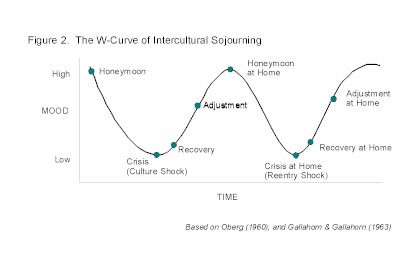
So I mentioned earlier that I want to track the effects of culture shock (handily illustrated-along with reverse culture shock- on the accompanying graph) on myself. According to the conventional wisdom, I should be in the "honeymoon" or "euphoria" period right now. I don't know if I am or not. To be honest, I'm kind of wondering if I'm too negative-minded to experience something like euphoria or a honeymoon period. Well, that's probably not true, but I don't think that I've experienced anything that could be called euphoria yet.
I'm having a good time here, of course, and am obviously taking active enjoyment of the experience, but my time here and my enjoyment thereof is generally tempered by a nagging thought at the back of my head that perpetually reminds me that I don't really belong here, that I'm taking a sojourn that I'll return from. The journey may be the destination, but the journey has an ending as well. This is all brought to mind, of course, by the practical considerations of not knowing the language, culture and general "feel" of where I am. So, I'm constantly giving myself these mental caveats when I have fun- that everything will always be at arm's legnth.
Make no mistake, I'm not trying to be cynical or give the impression that I'm having a bad time, but I don't think that at any point my enjoyment will overtake my reason.
On the other hand, though, I'm constantly recognizing that this whole venture is something singular. This is something that I'll probably talk to people about the rest of my life, as in "well, when I lived in Japan..." Thinking about that still gives me a nice little fuzzy feeling, so maybe that's all the honeymoon or euphoria that I'll be feeling.
I'm a little worried that I'm going to crash into homesickness rather hard. There have been a few moments where I've really, really missed home, and while they tend not to be overly strong, I'm worried about full-on incapacitating emo loneliness in the future. You know, the kind where you turn up the Joy Division really loudly and messily write "I AM SO ALONE!" in your own blood on what used to be a clean white wall. In other words, I have anxiety about the possibility that I'll have anxiety in the future. How dumb is that?
For the most part, things have seemed more or less normal. Not euphoria, not honeymoon, but good. Let's hope that persists.
